
Aim
Astro-COLIBRI collects follow-up observation reports for all transient events: gamma-ray bursts, supernovae, gravitational-wave and neutrino counterparts, optical transients, and more. For every event it gives the community a real-time overview of the follow-up campaigns carried out and a centralized, easily searchable record of who observed it, bringing together the photometric measurements, the contributing observatories, and the contacts behind them in one place.The goal is twofold: to let observers immediately see how an event is being followed up (which bands, when, and to what depth), and to make it straightforward to get in touch with the teams that collected data, facilitating the organisation of joint analyses, multi-instrument campaigns, and publications. Data arrives through two complementary channels: automatic parsing of public NASA GCN circulars, and direct observation reports submitted by registered observatories. For gamma-ray bursts, the collected optical photometry is additionally used to build the afterglow lightcurves described below.
Automatic AI parsing of GCN circulars
Astro-COLIBRI leverages a combination of regular expressions and Natural Language Processing (NLP) using Large Language Models (LLMs) to automatically read, interpret, and extract structured photometry from the free-text NASA GCN circulars posted by observatories worldwide. From each circular it pulls out the individual measurements (observation times, filters, magnitude values, upper limits, uncertainties, and (where reported) the redshift and spectral index) and attaches them to the corresponding event in near-real time.The pipeline, its validation, and its performance are described in F. Schüssler et al., "AI-Assisted Extraction of Follow-up Observations from GCN Circulars in Astro-COLIBRI", submitted, SciX.
⚠️ Caveat — automated extraction can contain errors.
Because circulars are written as free text by many different
authors, the automated parsing carries intrinsic uncertainties and
may occasionally misinterpret a value. In particular:
- Natural-language ambiguity: temporal references (e.g. "during the first night", "hours after trigger", "since trigger") can be parsed with minor offsets compared to strict, explicit time logs.
-
Filter & calibration variance: observers
use diverse and sometimes non-standard filter systems and
calibration references (Vega vs. AB). Astro-COLIBRI converts
everything to a common Cousins
RcAB system, but the conversion relies on standardized assumptions (such as a default spectral indexbeta = 0.7) that may not match the true spectrum of the event. - Always verify before publishing: users are strongly encouraged to cross-check extracted values against the original GCN circulars (the circular ID is included with every data point, and in both the CSV and VOTable downloads) before using them for any analysis. Beyond the circulars, the follow-up database also lets anyone contact the authors directly through the centralized contact record to confirm the measurements and request the original, fully calibrated, publication-ready data, a key step for joint analyses and publications.
Optical afterglow lightcurves & fitting (GRBs)
GRB events include an optical-afterglow context figure that places the current event on top of archival GRB afterglow measurements. The x-axis is the observed time since the GRB trigger, and the y-axis is a common observed-frame magnitude: a CousinsRc-equivalent
magnitude on the AB system. This common value is meant for visual
comparison of optical afterglow brightnesses; it is not a rest-frame
luminosity correction.
An example of the resulting afterglow figure, here for GRB 250403A, is
shown below: 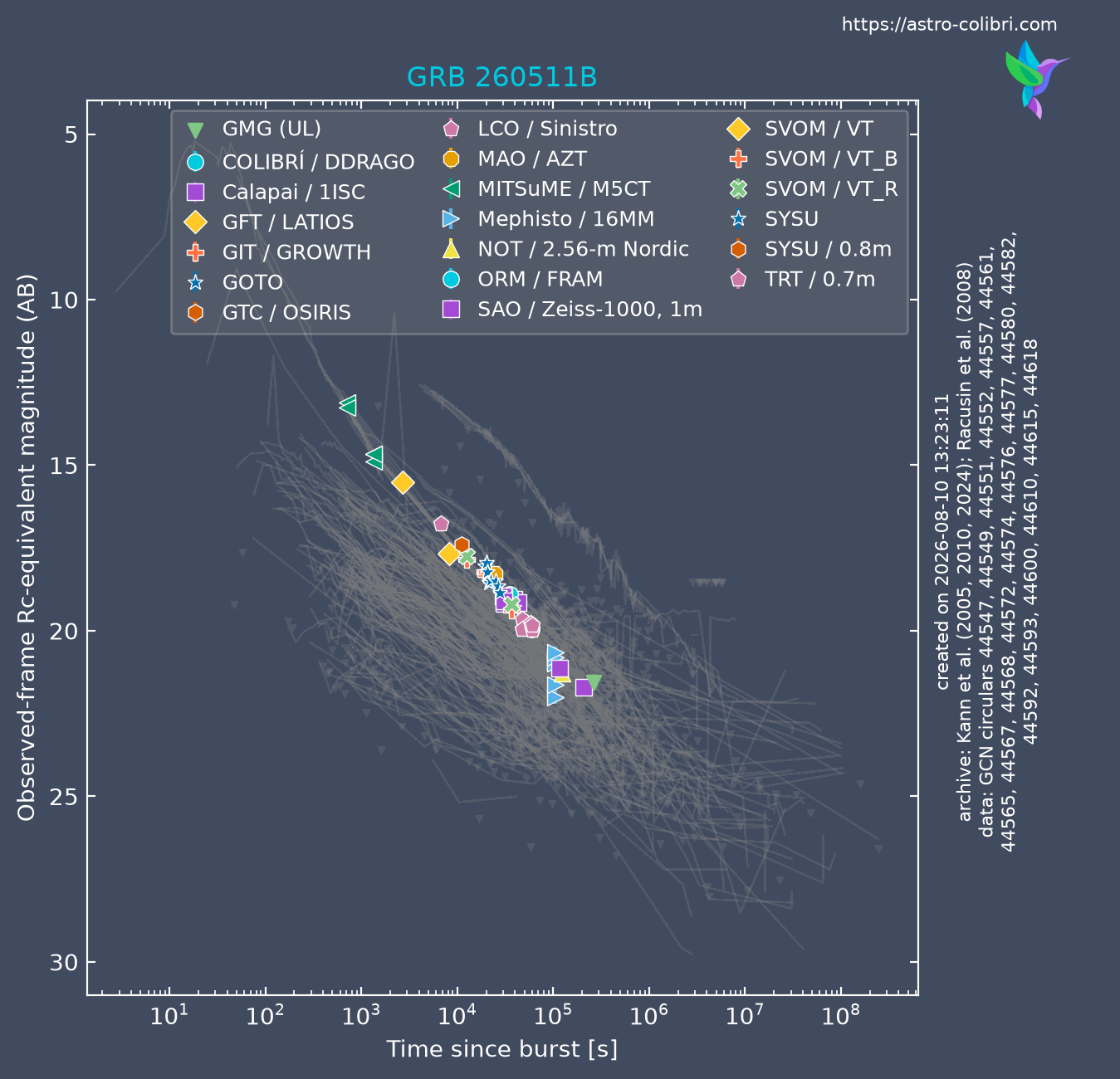
Common plotting magnitude. The archival comparison merges four machine-readable sources. Its recent component is Kann et al. (2024), A&A 686, A56, using the VizieR catalogue J/A+A/686/A56. Earlier Swift-era measurements come from the Kann et al. (2010) VizieR catalogue J/ApJ/720/1513. The complete pre-Swift TeX catalogue of Kann, Zeh & Klose (2005) supplies the earlier comparison curves, including GRB 030329. GRB 080319B is included from the machine-readable supplementary light curve of Racusin et al. (2008). This is necessary because the VizieR table associated with the 2010 paper contains its 840 newly published measurements, not every comparison light curve shown or discussed in that paper. After conversion, deduplication, and archival-display cleanup, the deployed comparison contains 8,283 measurements from 138 GRBs and XRFs. To keep malformed catalogue values and extreme limits from setting the plot scale, archival points fainter than magnitude 30 are removed, as are points brighter than magnitude 5 after 100,000 seconds and all upper limits brighter than magnitude 12. These display cuts apply only to the archival comparison; measurements for the current event remain visible.
The archival measurements are converted to the common
Rc AB system using beta = 0.7 without
applying an additional Galactic extinction correction. Rows in the
pre-Swift catalogue that were already corrected for Galactic
extinction are excluded because that correction cannot be safely
reversed without source-specific values. To keep the current-event
and archival points consistent in the same figure, Astro-COLIBRI
likewise does not apply an additional Galactic-extinction correction
to the magnitudes extracted from GCN circulars. New measurements are converted to the same common plotting magnitude. For a measurement reported in filter
f,
m_AB = m_raw + VegaToAB(f). The AB/Vega convention and
cross-filter comparison follow the standard magnitude and K-correction
notation of
Hogg et al. (2002). We then transform the AB magnitude to the common Cousins
Rc band assuming F_nu ∝ nu^-beta:
m_Rc,AB = m_AB + 2.5 * beta * log10(nu_Rc / nu_f),
equivalently
m_Rc,AB = m_AB + 2.5 * beta * log10(lambda_f / lambda_Rc). The spectral index beta is typically not reported in
GCN circulars, we thus assume a default value beta = 0.7.
Missing filters or unknown magnitude systems are kept in the database
with their raw values but are not used as common-magnitude photometric
points for the current event.
Mathematical models & fitting options. The extracted optical photometry can be fitted with two models to study the temporal decay and transitions:
-
Simple Power-Law (Default): Describes the standard power-law decay
of GRB afterglows:
F(t) = F₀ · t⁻ᵅ
whereF₀is the normalization constant andαis the temporal decay index. This fit requires at least two selected photometric detections. -
Smoothly Broken Power-Law (Beuermann Function): Used to describe
transitions in the optical light curves such as peaks, flat
plateaus, or jet breaks:
F(t) = F₀ · [ (t/t♭)ᵅ¹ⁿ + (t/t♭)ᵅ²ⁿ ]⁻¹/ⁿ
whereF₀is the flux normalization,t♭is the break/transition time,α₁andα₂are the pre- and post-break indices, andnis the sharpness of the transition. Due to the high number of free parameters, this model requires at least five selected photometric detections to fit.
- The extrapolation input is automatically pre-filled with the start of the selected observatory's visibility window to assist in observation planning.
- The extrapolated point is plotted on the figure as a star marker, and its exact date, time, and magnitude (in AB Cousins Rc band) are displayed in both the legend and the frontend info panel.
Registering & joining observatories
The follow-up database is community-driven. All Astro-COLIBRI users can register an observatory or observing network so that they can contribute observation reports and be listed among the teams that followed up an event.
What counts as an observatory?
Astro-COLIBRI primarily works with professional observatories, complemented by well organized and recognized networks of amateur astronomers and citizen scientists. Clubs, collaborations, groups, and observing networks that can coordinate follow-up and manage their own members are warmly invited to register. Individual amateur telescopes should not be registered as standalone observatories; independent observers are encouraged to join or coordinate through an existing club, group, or network.
Astro-COLIBRI primarily works with professional observatories, complemented by well organized and recognized networks of amateur astronomers and citizen scientists. Clubs, collaborations, groups, and observing networks that can coordinate follow-up and manage their own members are warmly invited to register. Individual amateur telescopes should not be registered as standalone observatories; independent observers are encouraged to join or coordinate through an existing club, group, or network.
-
Create a custom observatory or network. Provide a
name and a short identifier (the short name, e.g.
VLT,KNC, used as the unique key), a type (optical,radio,X-ray,gamma-ray, ormulti-messenger), and a contact email. Optional details (e.g. location, filters, field of view, wavelength and zenith range, and a website) help other teams understand the observatory's capabilities and facilitate the submission of observation reports. - Approval. New observatories are rapidly reviewed by the Astro-COLIBRI team before they appear publicly. The creator automatically becomes the observatory's first administrator and is notified once it is approved.
- Join an existing observatory. Rather than creating a duplicate, users can request to join an already-registered observatory. An administrator of that observatory grants or denies access; granted members can then submit reports on the observatory's behalf. Administrators can also promote other members to administrators.
- Notifications. Each approved observatory has its own internal push-notification channels so members and administrators stay informed about access requests and relevant follow-up activity.
Submitting observation reports
Members (and administrators) of a registered observatory can submit custom observation reports for an event directly, without going through a GCN circular. This is the recommended way to contribute data that is not (or not yet) public, and to make your team's contribution and contact details discoverable for joint work.- What a minimal report contains. The target event (identified by its trigger ID or source name), the contributing observatory, a contact name and email. This "observation report" indicates to the community that your observatory has collected data for the event allowing you to be listed among the follow-up teams and contacted for joint analyses.
- Adding observation results. To share preliminary measurements, you can optionally include a summary of the observations and the photometric data itself (time, filter, magnitude or upper limit, and uncertainty). This allows your reported points to be plotted in the afterglow figure and included in the photometry downloads alongside GCN-parsed data.
-
Same processing as GCN data. Reported photometry
is enriched exactly like circular-parsed data, time-since-trigger
and the common Cousins
RcAB magnitude are computed, so user reports and GCN points appear consistently in the same afterglow figure and downloads.
Photometry download (CSV & VOTable)
The entire compiled photometric follow-up of an event, from both GCN circulars and user reports, is available for download in CSV and VOTable formats. See the caveats about automated extraction above: cross-check the data against the original GCN circulars before using it for scientific analysis.CSV export. Each row is a single reported observation. The columns are:
-
time_utc: the observation's UTC date and time (ISO 8601, e.g.YYYY-MM-DDTHH:MM:SS.sss). -
time_mjd: the Modified Julian Date of the observation mid-point. -
time_since_trigger_s: time in seconds between the GRB trigger and the observation. -
filter: the filter band name (e.g.Rc,r,g). -
mag_raw: the raw reported magnitude (or upper limit). mag_err: the reported magnitude uncertainty.-
mag_rc_ab: the CousinsRcAB-system converted magnitude (used for plotting). -
is_upper_limit: boolean flag (true/false) indicating an upper limit. -
observatory: the name of the observatory (e.g.KNC,VLT). -
circular_id: the NASA GCN Circular ID containing the report (for GCN-parsed points).
- Standardized metadata and resource descriptions.
-
Field definitions mapping to standard Unified Content Descriptors
(UCDs), such as
time.epochfor the MJD,phot.magfor the magnitude, andpos.framefor coordinates. - Compatible with astronomical software tools such as TOPCAT, Aladin, or custom astropy scripts.
For general optical lightcurves built from survey and amateur-network data, see the optical lightcurve documentation.